
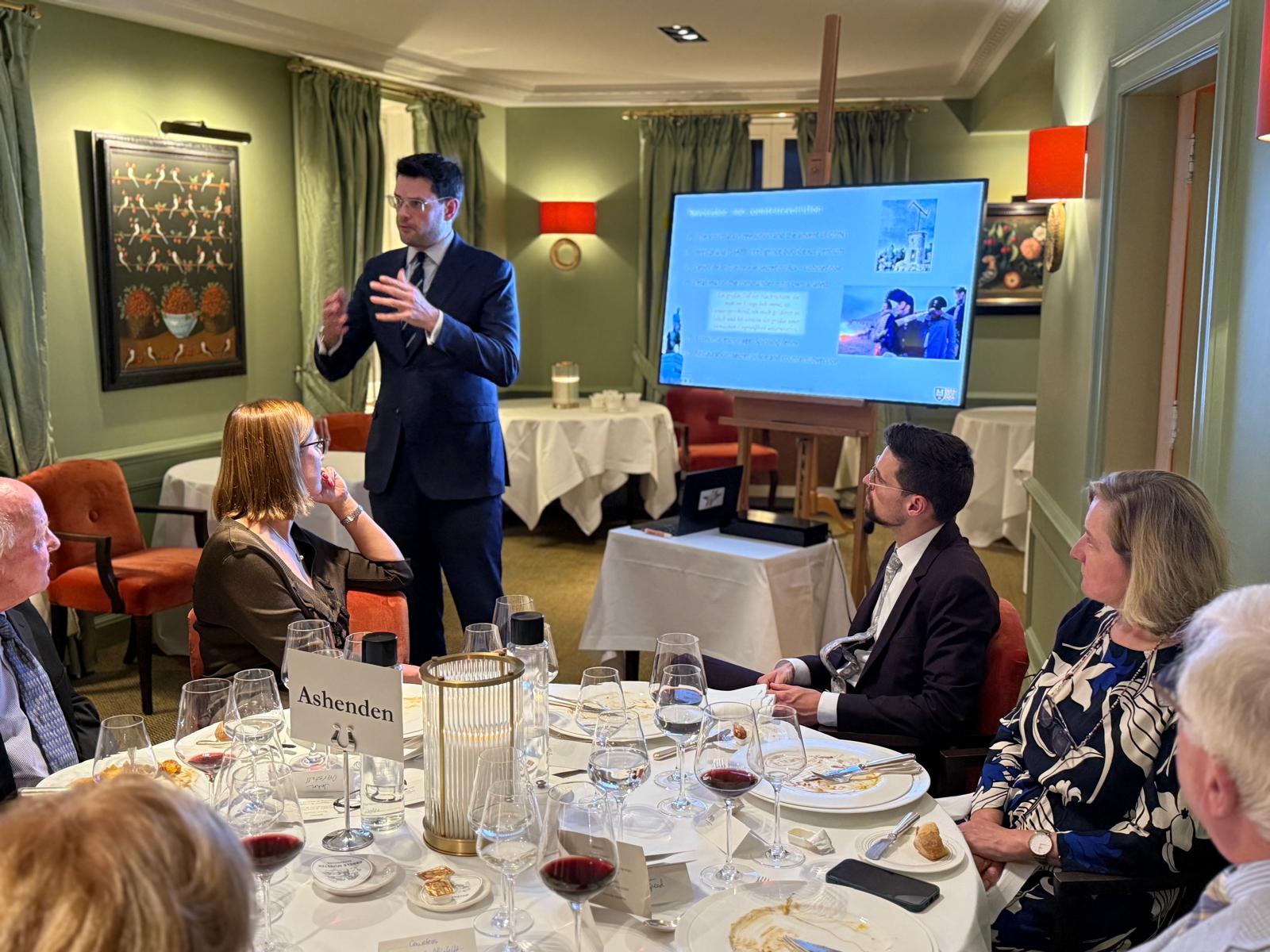
On 14 October 2025, The Cambridge Society of Luxembourg welcomed Prof. Dr. Kenneth Lasoen for a fascinating lecture that took the audience on a whirlwind tour through the history of espionage, from ancient scouts to modern‑day cyber warriors. In his lecture titled “Past, Present and Future of Intelligence,” Prof. Lasoen explored the role of intelligence in world history and showed how the craft continually adapts to technological, political, and societal shifts.
Origins and early traditions
Prof. Lasoen began in the ancient world: from the spies of Moses to Roman secret agents, intelligence was used to protect empires, suppress dissent, and outmanoeuvre enemies. Eastern traditions featured prominently, with Sun Tzu and Kautilya as canonical thinkers on deception, reconnaissance, and state security. Byzantine court intrigue and Arabic cryptography also took the stage as early examples of methodical information collection and secured communication — early signs of a craft where technique, strategy, and politics converge.
From the Middle Ages to the Cold War: professionalisation
Moving through the Middle Ages and Renaissance, espionage evolved alongside European power struggles. Examples ranged from Viking raids and Crusader scouts to the Cantino map operation, as well as the Vatican’s Sanctum Officium as one of the earliest institutional forms of a secret service. With the age of revolutions and industrialisation, the field became more structured: secret police, economic espionage, and military attachés took root. In the early 20th century, modern services such as MI5 and MI6 emerged, while espionage fiction began to shape the public imagination.
World War I and II brought a technological watershed that accelerated signals intelligence (SIGINT) and imagery intelligence (IMINT). Intelligence coalitions formed, and spycraft together with communications decryption became decisive factors in the outcome of conflicts during the Second World War. Afterwards, the Cold War turned intelligence into a global power game: agencies like the CIA and KGB became household names, and their respective blocs kept each other under constant watch.
Today and tomorrow: data, AI and cognitive warfare
After the fall of the Soviet Union, 9/11 marked a new phase in which intelligence became central to countering terrorism, cyber threats, and disinformation. Today’s landscape, Prof. Lasoen argued, is shaped by big data, artificial intelligence, biometrics, and quantum computing, forces that create both opportunities and vulnerabilities. He warned of the rise of cognitive warfare, where perception itself becomes a battleground, and where surveillance and intelligence are no longer the exclusive domain of governments. Open‑source intelligence (OSINT) has democratised the trade: every citizen with a smartphone has become a real‑time sensor and an analyst of the events around them.
Prof. Lasoen closed with a clear message about competitive advantage in a deeply networked world. “Intelligence is key to having an advantage over others, to be ahead of them,” he said. “The future is sensemaking — and using it wisely.”
Want to know more about the work of intelligence?
Curious about intelligence services, counterintelligence, deception operations, and protection against technical espionage? The Security Intelligence Knowledge Center (KSI) provides training and advisory services in threat analysis and intelligence tradecraft. Discover our programs on the website or get in touch via info@ksi.institute